
Course Description
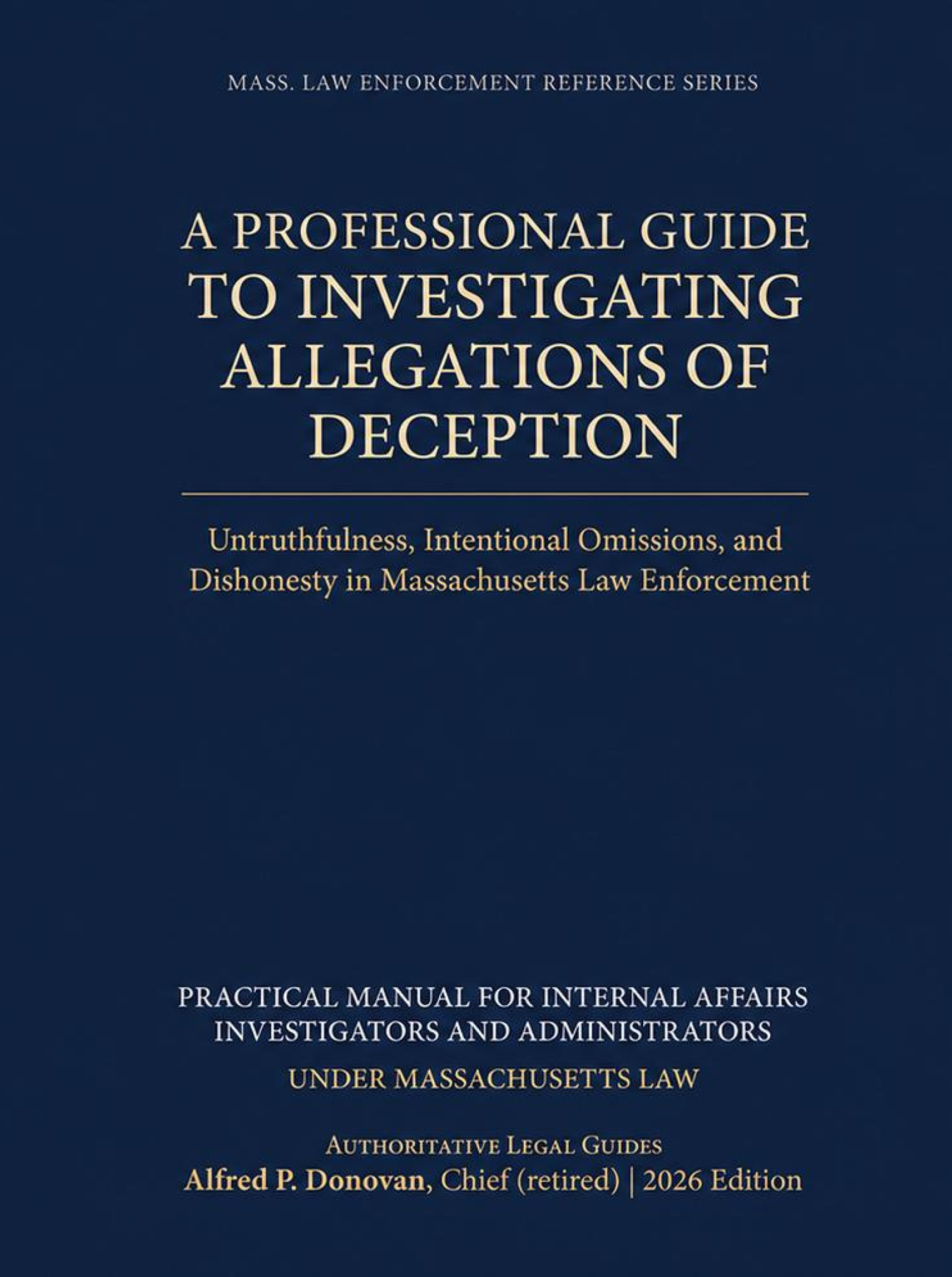
Recent police misconduct decisions, Massachusetts case law, and guidance issued by the Massachusetts POST Commission under M.G.L. Chapter 6E have established a clear statewide standard for truthfulness and untruthfulness among Massachusetts police officers. The law also identifies when untruthfulness requires separation from service and when lesser disciplinary action may be appropriate.
This seminar explains the standards expected of Massachusetts police officers and the consequences that follow when misconduct demonstrates that an officer is unfit to remain in the profession because of untruthfulness or the seriousness of the conduct involved. Departments should maintain a written truthfulness policy; a sample policy will be provided.
Cases to Be Discussed
| Massachusetts Cases | Related Authority |
| Michael P. Carney v. City of Springfield et al. | Brady v. Maryland |
| City of Boston v. Boston Police Patrolmen’s Association (1) | Giglio v. United States, 405 U.S. 150 (1972) |
| MASSACIIUSETTS PAROLE BOARD v. WAXMAN, et al’ No. 932254. Superior Court of Mass | NLRB v. J. Weingarten, Inc., 420 U.S. 251 (1975) |
| City of Pittsfield v. I.B.P.O. Local 447 (1) | LaChance v. Erickson |
Topics to Be Discussed
The Three Classic Types of Deception
- Falsifying an official police document or record
- Fabricating false evidence or facts
- Omitting material facts
Duty to Disclose Untruthfulness and Dishonesty
- Whose responsibility is it to provide information?
- What are the police chief’s responsibilities?
- What is a Discovery Notice?
- Who must be notified?
Scope of the Truthfulness Standard
The truthfulness standard applies to the following documents, processes, and proceedings:
- Job applications
- Employment history forms
- Medical forms
- Police reports
- Overtime slips
- Detail slips
- Search warrant applications
- Police logs
- Court testimony
- Disciplinary hearings
- Testimony under oath
- Administrative investigations
Statutory Definition
M.G.L. Chapter 6E, Section 1 — Definitions
“Untruthful” or “untruthfulness” means knowingly making an untruthful statement concerning a material fact, or knowingly omitting a material fact:
|
Included with this training ($65 value)